
Introduction: Why Bio-Security is Your Farm’s Silent Guardian
In the global poultry industry, the difference between a profitable cycle and a total loss often comes down to one thing: Bio-security. Whether you are managing a fast-growing Broiler flock or a high-value Breeder operation, your birds are constantly under threat from invisible enemies—viruses, bacteria, and fungi.
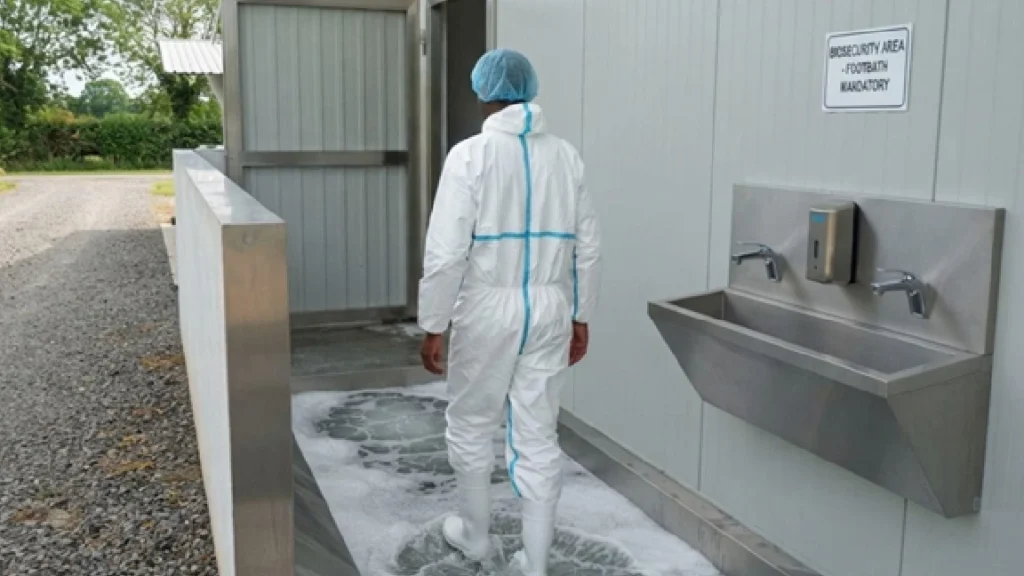
Bio-security is not just a set of rules; it is a holistic management mindset. It is the practice of excluding disease-causing agents from your farm and preventing their spread within the premises. In this comprehensive guide, we will explore the professional protocols required to build an unbreakable shield around your poultry investment.
1. Minimum Ventilation: The Foundation for Young Chicks
During the brooding stage, air quality is just as critical as temperature. Poor ventilation leads to a buildup of carbon dioxide (CO2) and moisture, causing wet litter and poor chick starts.
- The Precision Approach: Leading global ventilation systems use automated air inlets that open precisely to mix incoming cold air with the warm air at the ceiling. This prevents cold drafts from hitting the chicks directly while keeping the air fresh.
- Benefit: Uniform air distribution ensures that every chick in the house, regardless of its location, grows at the same rate.
2. Mastering Tunnel Ventilation for Heat Stress
As broilers grow and produce more metabolic heat, the strategy must shift.

- The Wind Chill Effect: High-performance tunnel ventilation systems use powerful, energy-efficient fans to pull air across the length of the house. This creates a “breeze” that cools the birds through convection.
- Quality Equipment Matters: When using fans and cooling pads designed to European quality standards, you achieve a higher air exchange rate with lower electricity consumption. This is where the difference between “standard” and “professional” equipment shows in your monthly bills.
3. The Critical Link: Humidity and Litter Quality
Humidity is the silent enemy of FCR. High humidity prevents birds from cooling themselves and leads to ammonia release from wet litter.Sensor-Driven Control: Top-tier climate controllers use high-accuracy humidity sensors to adjust fan speeds automatically. When the system detects a rise in relative humidity, it increases air exchange to dry the litter without dropping the house temperature too rapidly.
4. Why Professional Standards Outperform Local Fixes
Investing in systems that meet global poultry engineering standards provides several advantages:
- Durability: Motors and shutters designed for high-ammonia environments last significantly longer.
- Precision: Digital controllers can manage air changes down to the cubic meter, ensuring no energy is wasted.
- Bio-security: Properly ventilated houses have lower dust levels, reducing the transmission of airborne pathogens.
Conclusion: Precision Air for Maximum Profit
Ventilation is a 24/7 balancing act between temperature, humidity, and air purity. By choosing ventilation solutions that adhere to the highest industry standards, you remove the guesswork from your operation. A fresh house is a healthy house, and a healthy house is a profitable one.