Introduction: The Biological Trigger
In the world of poultry breeding, light is the primary driver of the reproductive system. Unlike broilers, where the goal is rapid muscle growth, lighting for Breeders is focused on “Photo-stimulation.” This is the process of using light to signal the bird’s brain to begin hormone production for egg laying. A well-managed lighting program ensures that the flock reaches sexual maturity at the same time, leading to high peak production and long-term persistency.
1. The Rearing Phase: Preventing Early Maturity
During the first few weeks (rearing), the goal is to keep the birds’ reproductive systems “quiet” so they can focus on skeletal and immune development.
- Controlled Dark-Out: In modern breeder houses, total light control is essential. By providing a short day-length (usually 8 hours of light), we prevent the birds from maturing too early.
- The Risk of Early Stimulation: If breeders are exposed to too much light or high intensity too soon, they will start laying small, unusable eggs, and their overall lifetime production will drop significantly.
- Uniformity is Priority: Low light intensity (around 5-10 Lux) during this stage keeps the flock calm and ensures they grow at a uniform rate.
2. Photo-stimulation: The “Golden Shift”
Once the flock reaches the target body weight and age (usually around 21-22 weeks), it is time to “turn on” their reproductive system.
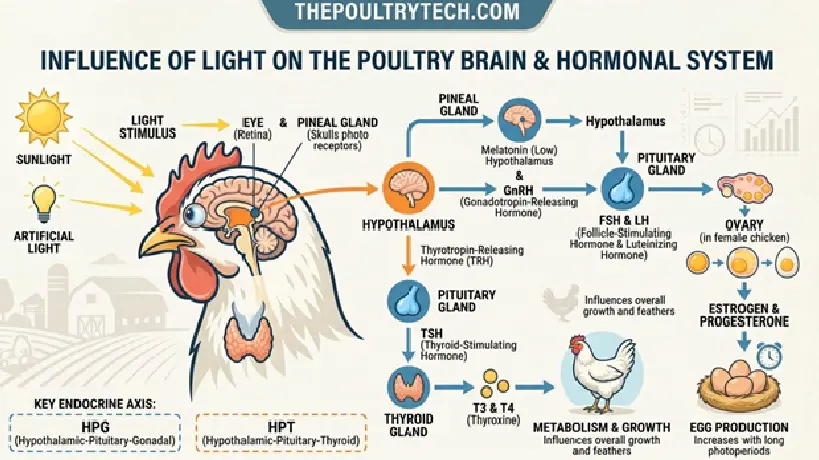
- The Light Jump: This is done by increasing the day length from 8 hours to 11 or 12 hours initially, then gradually up to 14-16 hours.
- Intensity Increase: Along with the duration, the intensity is often increased (to 30-60 Lux). This sudden change triggers the hypothalamus in the bird’s brain to release hormones that start egg yolk development.
- Timing is everything: Stimulation must never happen based on age alone; it must be based on the body weight and fat reserves of the birds.
3. The Role of the Red Spectrum
While blue and green light are good for broilers, Red light is the king for Breeders.
- Hormonal Response: Red wavelengths (600–700 nm) penetrate the bird’s skull more effectively to reach the photosensitive cells in the brain. This specifically stimulates the production of reproductive hormones.
- Better Egg Production: Research shows that breeders under a spectrum rich in red light tend to have better laying persistency and higher fertility rates compared to those under standard white light.
4. Managing the “Sunset” Effect
Sudden changes in light can cause stress and physical injury.
- Sunrise/Sunset Simulation: High-quality automated systems gradually increase and decrease light levels over 15-30 minutes.
- Nest Training: This gradual dimming signals the birds that “night” is coming, encouraging them to find their perches or nesting areas safely, reducing the number of floor eggs.
5. Maintaining Persistency: Avoiding Photo refractoriness
As a flock ages, they can become “blind” to the light signal—a condition called photo refractoriness.
- Constant Monitoring: To prevent a rapid drop in production after the peak, it is vital to never decrease the day length or light intensity during the laying period.
- Maintenance Levels: Once the maximum day length (e.g., 16 hours) is reached, it must be maintained strictly until the end of the flock’s life.
Conclusion: Lighting as a Management Tool
For a breeder manager, the lighting system is like a steering wheel. It allows you to synchronize the flock, time the onset of lay, and maximize the number of high-quality hatching eggs. By investing in a system that offers spectrum control and precise dimming, you are not just buying bulbs— you are laying the essential foundation for the success of the industry.