Introduction: The Golden Window of Chick Development
In poultry production, the first seven days of a chick’s life represent a critical, high-stakes window. When a day-old chick arrives at the farm, its physiological systems are still highly immature. It cannot regulate its own body temperature, its immune framework is basic, and its digestive tract is transitioning from yolk absorption to feed utilization. What happens during these initial 168 hours dictates the flock’s lifetime performance, uniform growth, and overall Feed Conversion Ratio (FCR). Industry data consistently shows that a single gram of body weight gained at day seven translates to an extra 6 to 7 grams at market age. Therefore, precision brooder management is not just a routine farm chore; it is a vital economic driver.
1. Pre-Placement Preparation: The Biosecurity Foundation
Success in the brooding phase begins long before the delivery truck arrives. A minimum down-time of 14 days between flocks is a standard biosecurity prerequisite to break pathogen cycles.
- Cleaning and Disinfection: The brooding zone must be thoroughly washed, sanitized, and dried. All feeding and drinking equipment must be dismantled, flushed with clean water, and treated with food-safe disinfectants.
- Pre-Heating the House: This is a step where many producers stumble. It is not enough to just warm the air; the concrete floor or litter material itself must be heated. Brooders should be turned on 24 to 48 hours prior to chick arrival. The target floor temperature must reach a steady 32°C (90°F) before any birds are placed. Cold floors absorb body heat rapidly through the chicks’ feet, leading to huddling, reduced mobility, and early mortality.
2. Temperature Control: Embracing Thermal Comfort
Because day-old chicks are poikilothermic, they rely entirely on the ambient environment to maintain their core body temperature.
- The Comfort Zone: Start with an air temperature of 33°C to 35°C (91°F to 95°F) at bird level during day one. This temperature should be gradually decreased by roughly 0.5°C each day, reaching approximately 30°C by the end of week one.
Reading Bird Behavior: While digital thermostats are highly useful, the ultimate indicator of success is the behavior of the chicks. To ensure optimal health during the first week, managers should observe the following behavioral indicators:
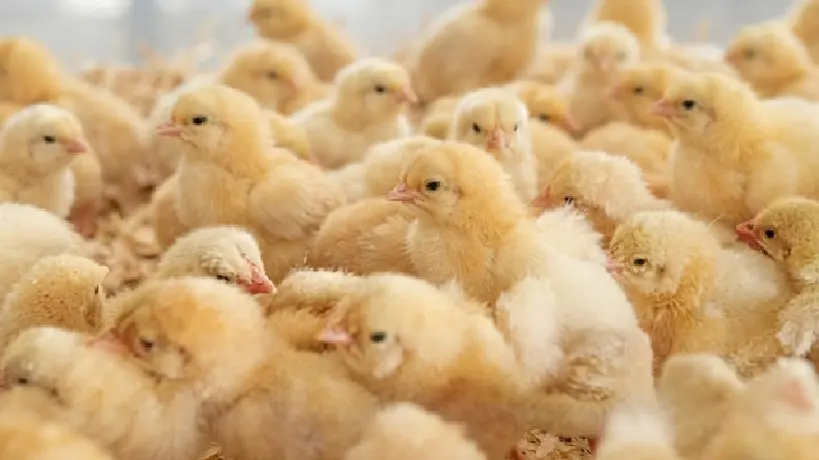
Comfort Zone Indicators (The Ideal State):
- Distribution: Chicks are evenly scattered throughout the brooding area.
- Activity: Chicks are actively eating and drinking.
- Sound: Soft, pleasant chirping.
Stress Indicators (Immediate Action Required):
- Huddling (Cold Stress): Chicks are tightly clustered underneath the heat source, often chirping loudly/distressed.
- Panting (Heat Stress): Chicks are crowded against the walls or away from heat sources, exhibiting open-mouth panting.
- Inactivity: Chicks appear lethargic or motionless, failing to explore the feed and water lines.
3. Feed and Water Management: The Catalyst for Gut Health
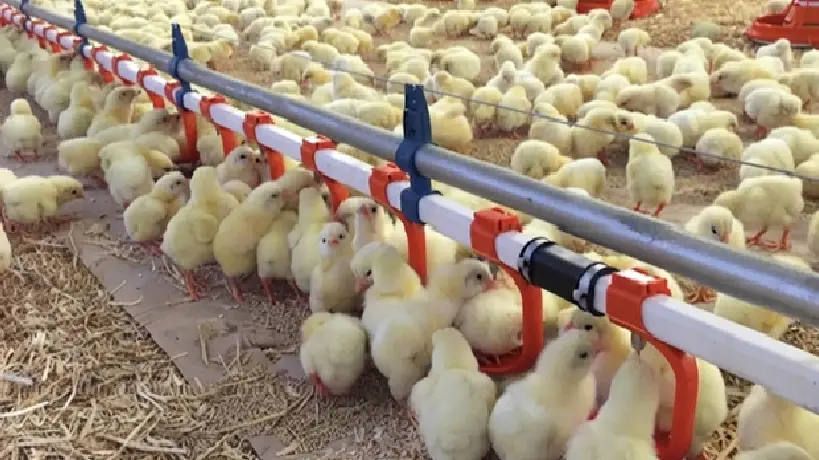
Early access to feed and clean water triggers the rapid development of the chick’s intestinal villi, maximizing nutrient absorption capacities for the rest of their lives.
- Water First: Chicks must find water immediately upon placement. The hydration process helps flush out metabolic waste and stimulates appetite. The drinking water should be cool but not freezing—ideally around 18°C to 22°C. Nipple drinkers must be adjusted to the chicks’ eye level, and water pressure should be set low enough so that a tiny drop forms at the tip without leaking.
- Crop Fill Assessment: To verify if chicks are successfully navigating the brooding zone, managers use the “Crop Fill Test.” Check a random sample of 100 chicks 24 hours after placement.
- Target: At least 95% of the sampled crops should be soft and rounded, indicating a healthy mix of both feed and water. If the crop feels hard and gritty, the chick has found feed but not enough water. If it is watery and loose, they are drinking but not eating.
| Status | Crop Feel | Interpretation |
| Excellent | Soft and round | Healthy intake of both feed and water |
| Suboptimal | Hard and gritty | Found feed, but insufficient water intake |
| Critical | Watery and loose | Consuming only water, not eating feed |
4. Lighting and Ventilation: Balancing Oxygen and Rest
The atmospheric environment during week one requires careful balancing to support rapid organ growth without causing respiratory stress.
- High-Intensity Lighting: During the first 24 to 48 hours, give the chicks 23 hours of bright light (30–40 Lux) followed by 1 hour of darkness. This helps them identify the physical layout of feed and water lines easily. After day two, introduce a structured dark period (4 to 6 hours) to promote skeletal development and biological rest.
- Minimum Ventilation: Chicks produce significant amounts of moisture and carbon dioxide (CO2), while brooder heaters generate carbon monoxide (CO). Minimum ventilation systems must run on automatic timers to constantly replace stale gases with fresh, oxygen-rich air. The relative humidity should be kept between 60% and 70% to prevent the chicks’ respiratory tracts from drying out.
5. Maximizing Spatial Uniformity
Chicks must never have to travel far to find life-sustaining resources during their first few days.
- Brooder Surrounds: Use circular brooder rings or cardboard guards to keep chicks close to the heat, feed, and water source for the first 3 days. This prevents them from wandering into cold, dark corners of a large house where they might starve.
- Supplementary Feeding: In addition to standard automated feeding pans, use paper sheets or plastic trays covering at least 25% of the brooding area. Scatter crumbled starter feed on these papers. The sound of chicks walking on the paper attracts other chicks to peck and feed, accelerating flock socialization and early intake.
Conclusion: The Dividend of a Strong Start
The first 7 days of brooder management lay the track for the entire production train. A manager who pays meticulous attention to floor temperature, chick behavior, clean water delivery, and atmospheric quality will see a massive dividend at the end of the flock cycle. Minimizing early stress and maximizing day-seven weight uniformity ensures a resilient, healthy flock that converts feed efficiently and yields exceptional processing results.